Contact Us
- JL. Kyai Tapa No. 1 Grogol
- Jakarta Barat, Indonesia
- Phone:
- (62-21) 566 3232
- Official Universitas Trisakti:
- (+62) 813-1530-9978
- Whatsapp:
- (+62) 882 194 856 74
- (+62) 877 707 077 03
- Fax: (62-21) 564 4270
- Email: humas@trisakti.ac.id


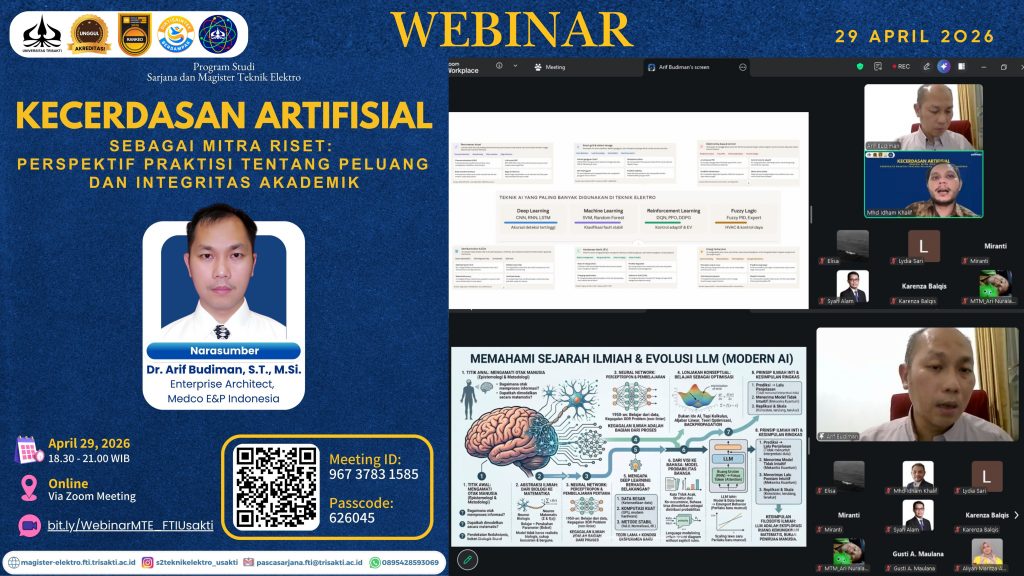
Jakarta – The Undergraduate and Master’s Programme in Electrical Engineering, Faculty of Industrial Technology, Universitas Trisakti successfully held a webinar entitled “Artificial Intelligence as a Research Partner: A Practitioner’s Perspective on Opportunities and Academic Integrity” on Wednesday, 29 April 2026, via Zoom Meeting.
The webinar featured Dr Arif Budiman, S.T., M.Si., Enterprise Architect at Medco E&P Indonesia, as the keynote speaker. During the session, he shared insights into the development of Artificial Intelligence (AI), its implementation in industry, and its role in supporting research and academic activities.
In his presentation, Dr Arif Budiman discussed the evolution of modern AI and various AI techniques widely applied in Electrical Engineering, including Deep Learning, Machine Learning, Reinforcement Learning, and Fuzzy Logic. He also highlighted the growing opportunities for AI utilisation in technological development and scientific research. Furthermore, he emphasised the importance of maintaining academic integrity in the use of AI, particularly within higher education institutions.
The webinar was conducted interactively and received enthusiastic participation from lecturers, students, and academics. The discussion explored how AI can be utilised wisely as a research-support tool without compromising academic ethics, creativity, and the originality of scholarly work.
Through this event, the Undergraduate and Master’s Programme in Electrical Engineering, Faculty of Industrial Technology, Universitas Trisakti hopes to enhance academic understanding of both the opportunities and challenges presented by AI in the era of digital transformation, while encouraging its responsible application in education and research activities.
This webinar also reflects the programme’s commitment to providing academic forums that remain relevant to current technological advancements and to supporting the improvement of research quality and innovation within the academic community.


Copyright © – 2023 Trisakti University. Copyright is protected by law
