Contact Us
- JL. Kyai Tapa No. 1 Grogol
- Jakarta Barat, Indonesia
- Phone:
- (62-21) 566 3232
- Official Universitas Trisakti:
- (+62) 813-1530-9978
- Whatsapp:
- (+62) 882 194 856 74
- (+62) 877 707 077 03
- Fax: (62-21) 564 4270
- Email: humas@trisakti.ac.id


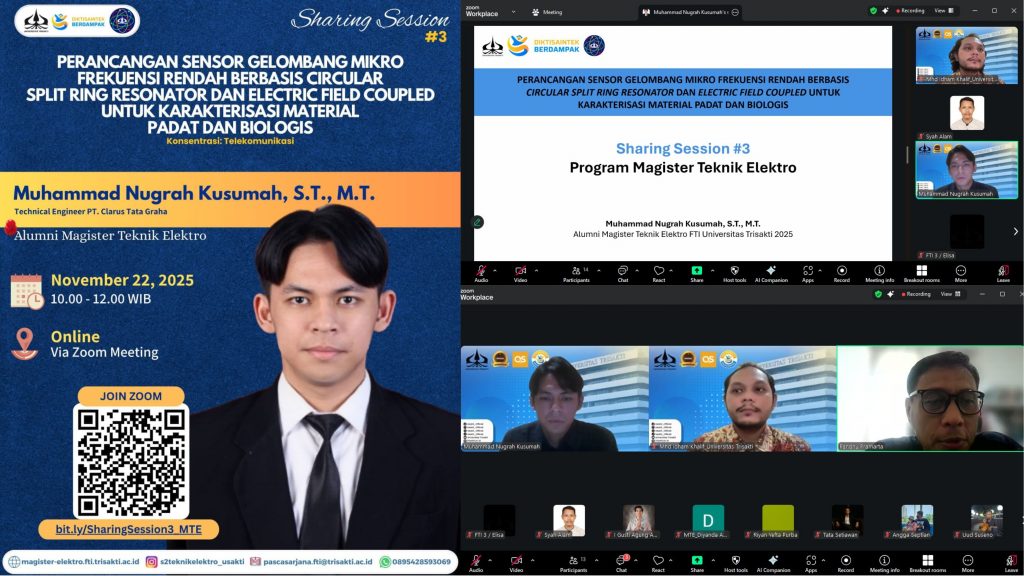
Jakarta, 22 November 2025 — The Master of Electrical Engineering Programme at Universitas Trisakti successfully held its third Sharing Session online via Zoom. The event featured an alumni member as the guest speaker and was attended by students, lecturers, and participants with a keen interest in sensor technology and microwave engineering.
The session was officially opened by the Head of the Master of Electrical Engineering Programme, Dr. Syah Alam, S.Pd., M.T., Ph.D., who emphasised the importance of mastering sensor technology and material characterisation in today’s rapidly evolving technological landscape. He noted that such knowledge-sharing activities are highly valuable for students, especially when delivered by practitioners and alumni with real industry experience.
The event was moderated by the Programme Secretary, Mr. M. Idham Khalif, S.Kom., M.T., who ensured that the session proceeded smoothly, effectively, and interactively.
The speaker for the event, Muhammad Nugrah Kusumah, S.T., M.T., an alumnus of the Master of Electrical Engineering Programme and currently a Technical Engineer at PT. Clarus Tata Graha, delivered an in-depth presentation on the design and implementation of microwave sensors based on Circular Split Ring Resonator (CSRR) and Electric Field Coupled (ELC) structures for material permittivity measurement.
His presentation covered several key points:
Following the presentation, the session continued with a question-and-answer segment. Participants were enthusiastic and posed insightful questions on sensor design challenges, measurement accuracy, and opportunities for further development of resonator-based technologies for medical and industrial applications. The discussion was lively and enriched the understanding of all attendees.
Sharing Session #3 concluded successfully and received positive feedback from participants. The Master of Electrical Engineering Programme remains committed to organising similar activities as part of its efforts to enhance academic competence, expand knowledge, and strengthen networking between students, alumni, and industry professionals.


Copyright © – 2023 Trisakti University. Copyright is protected by law
